Jacket fit — the seven points
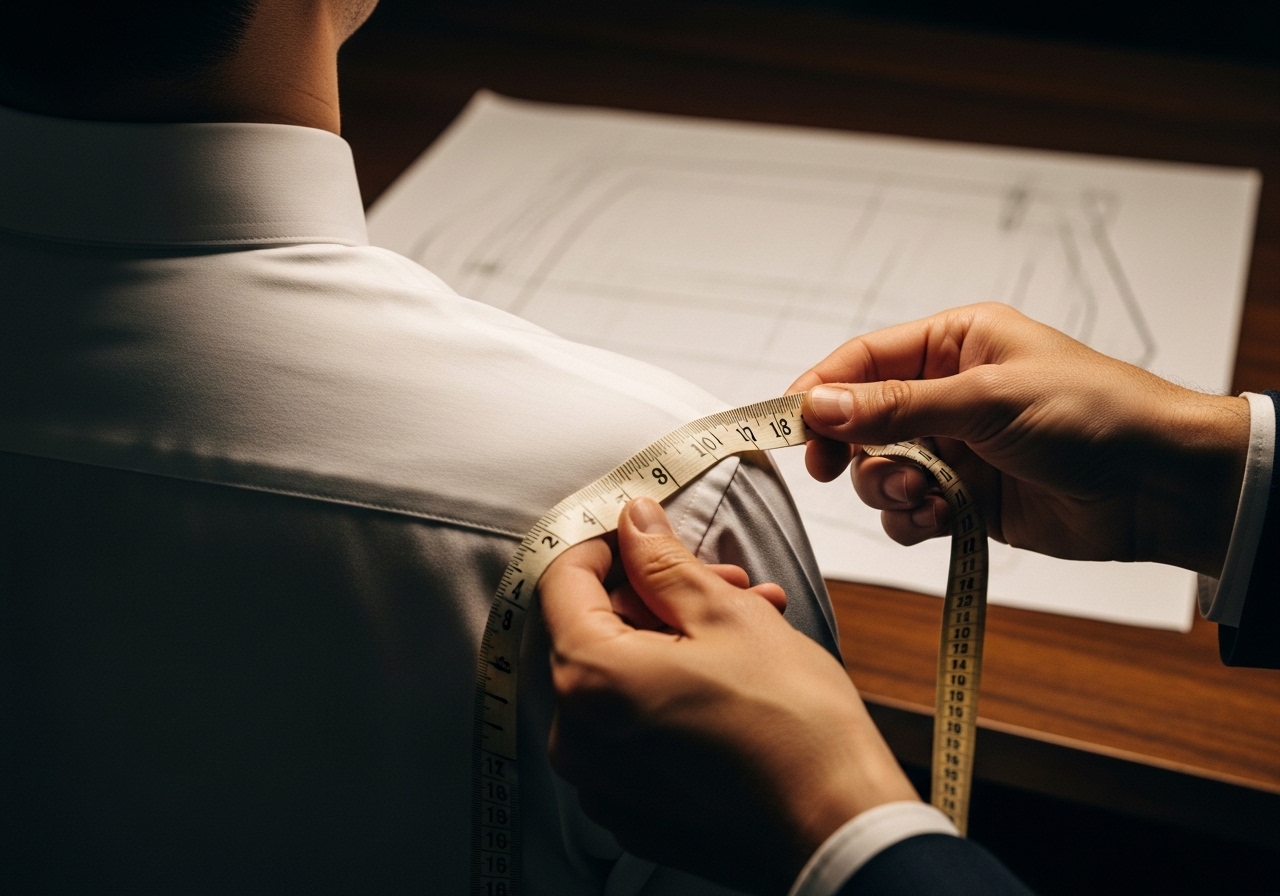
1. The shoulder. The shoulder seam — the line where the jacket shoulder meets the sleeve head — should sit exactly at the edge of the shoulder, no wider and no narrower. Too wide, and the sleeve fabric bunches at the armhole. Too narrow, and the jacket pulls across the upper chest and restricts arm movement. The shoulder seam cannot be moved significantly after a jacket is made; it is the reference point from which every other fit decision flows.
2. The collar. The jacket collar should follow the line of the shirt collar from behind, sitting approximately one centimetre below it, with no gap between collar and shirt at the back of the neck. A collar that pulls away from the neck at the back indicates a back balance problem; a collar that presses into the neck is too high. Either is a pattern issue that a bespoke garment should resolve.
3. The chest. When buttoned, the jacket front should lie flat without pulling or puckering. There should be enough ease to allow you to move your arms forward without the jacket straining across the back, but no excess that creates a boxy appearance. The front edges should meet cleanly when the button is fastened, without a gap below the button or a pull across the waist.
4. The waist suppression. A well-fitted jacket follows the body's silhouette — wider at the chest, suppressed at the waist, slightly flared at the hips. The degree of suppression is a matter of personal preference within limits: a very heavily suppressed waist looks fashionable but restricts movement; no suppression at all creates a boxy silhouette that does not represent the body well. We discuss the desired silhouette at the first consultation and draft the pattern accordingly.
5. The sleeve. The sleeve length should allow approximately 1 to 1.5 centimetres of shirt cuff to show below the jacket sleeve. The sleeve should hang straight from the shoulder with no twist or pull. The sleeve head — where the sleeve joins the jacket body — should be smooth, with no puckering or pulling.
6. The jacket length. Jacket length is both a functional and an aesthetic question. A classic guideline is that the jacket hem should cover the seat; another is that the jacket length should roughly equal half the sleeve length. Contemporary fashion runs slightly shorter; traditional tailoring runs to the seat. We discuss this at the consultation and decide on the length that works for the specific garment and the specific client.
7. The lining and interior. When the jacket is worn, the lining should not show at the front. The inside of the jacket should sit smoothly against the shirt, with no bunching or pulling that creates visible ridges through the outer cloth.
Trouser fit — the four critical points
1. The waist and seat. The trouser waist should sit comfortably at the natural waist without a belt for support (a well-fitted trouser does not need a belt to stay up). The seat should be full enough to sit without pulling across the back but not so full that it creates excess below the seat. The relationship between the waist, seat and rise measurements is the most complex in trouser fitting and is the area most frequently compromised in ready-to-wear.
2. The rise. The rise is the distance from the crotch point to the waistband. Too short a rise creates discomfort when seated and a pulling tension across the front. Too long a rise creates excess fabric below the waistband that bunches and looks careless. The correct rise is specific to each body — it is influenced by torso length, how the weight is carried, and personal preference for where the waist sits.
3. The thigh and knee. The trouser leg should follow the leg closely enough to look tailored but not so closely as to restrict movement. There should be no horizontal pull marks across the thigh, which indicate the trouser is too tight. There should be no excess vertical fabric at the knee, which indicates the taper is wrong for the leg.
4. The break. The break is the small fold of trouser fabric that forms where the hem meets the shoe. A full break (one fold, sitting on the shoe) is traditional and creates a clean vertical line from hip to floor. No break (hem sitting just above the shoe) reads as more modern. The choice is personal and we accommodate both.
Shirt fit — what makes a bespoke shirt different
The shirt is the one garment people wear against their skin every day, and yet most people have never worn one that fits correctly. The critical points in shirt fit are: the collar (which should close around the neck without gap or constriction — you should be able to insert one finger between collar and neck when buttoned); the shoulder seam (same principles as the jacket); the chest ease (enough to move freely without pulling across the back); the sleeve length and cuff (the cuff should sit at the wrist bone, allowing the cuff to show below a jacket sleeve); and the shirt body length (long enough to stay tucked reliably when moving).
A bespoke shirt resolves the most common ready-to-wear shirt problems: the collar that is simultaneously tight at the neck and too large at the points; the shoulder that pulls; the body that is either too tight across the chest or ballooning with excess around the waist. When a shirt fits correctly, it is invisible in the best sense — it is simply there, doing its job, without demanding your attention.
The measurements we take
For a bespoke suit jacket, we take a minimum of eighteen measurements. These include: chest circumference at the widest point; chest circumference at the high point (below the armhole); waist; seat; back width; back length from collar to waist and from collar to seat; front length; shoulder width; arm length from shoulder to wrist; upper arm circumference; neck circumference; and various diagnostic measurements for posture — back slope, shoulder angle, and any asymmetries between the left and right sides of the body.
For trousers, we take: waist (natural), hip, seat, thigh, knee, calf, rise (front and back), and outseam and inseam lengths.
For shirts: neck, chest, waist, seat, shoulder, sleeve, cuff, and shirt length.
These measurements are taken carefully and recorded in your file. They are the foundation of your personal pattern. If you have measurements taken elsewhere — at a different tailor, from a suit you own that fits well — we may be able to use these as a starting reference, though we will always measure independently and use our own measurements as the primary reference for the pattern draft.
What to bring to a fitting
For a jacket or suit fitting, wear the shirt and shoes you plan to wear with the finished garment. The shirt's collar determines how the jacket collar sits; the shoe's heel height determines the trouser length. Wearing a different shirt or different shoes at the fitting introduces variables that will require adjustments at the final fitting.
If you plan to carry items in the jacket pockets — a wallet, a phone, a notebook — bring them to the fitting. Loaded pockets change the way a jacket hangs and the way the front sits. A jacket that is fitted without considering the usual load may pull differently when worn with that load.
Wear or bring any garments that will be worn under the jacket — a waistcoat, a thick-knit sweater for an overcoat — if these affect the fit of the garment being fitted. Fitting a jacket intended to be worn over a waistcoat without the waistcoat will produce a jacket that does not accommodate the waistcoat correctly.