Switzerland's approach to fine cotton — precision without the marketing
Switzerland has no cotton-growing tradition — the country neither grows cotton nor historically had the industrial history in cotton that England and France developed in the eighteenth and nineteenth centuries. What it brings to fine shirting is something different: the precision and consistency of Swiss manufacturing standards applied to a material that benefits from those qualities more than almost any other textile.
Alumo weaves their cotton in Appenzell, in a facility that has operated continuously since the mill's founding in 1893. The weaving process, the finishing process, and the quality control that precedes the cloth reaching the market reflect the Swiss commitment to making things correctly the first time. There are no seconds in the Alumo range — the cloth that goes to the shirtmakers they supply meets their standard, or it does not leave the mill.
This consistency is worth more than it sounds. In fine shirting cotton, the cloth's performance across repeated washing and wearing is partly a function of the consistency of the weave — threads that are evenly tensioned, evenly spaced, and processed with uniform care hold their character through the life of the shirt in a way that inconsistent cloth does not.
Egyptian extra-long-staple cotton — the best fibre for fine shirting
Alumo specifies Egyptian extra-long-staple cotton as their raw material. The distinction between long-staple and short-staple cotton is the length of the individual cotton fibres: longer fibres can be spun into finer, more uniform yarns with a smoother surface and greater tensile strength. Egyptian extra-long-staple cotton — grown in the Nile delta — is the standard reference for the finest shirting cotton available, with fibre characteristics that no other cotton-growing region consistently matches.
In a finished shirt, the difference between fine Egyptian cotton and conventional cotton is apparent first in the hand — a smoothness against the skin that has no friction or roughness — and over time in the durability through washing. Fine Egyptian cotton shirts in good construction do not pill, do not develop a rough surface after repeated laundering, and do not fade unevenly. They wear in rather than wearing out.
For Chennai's climate, the breathability of fine cotton against the skin is a genuine practical advantage. A well-woven fine poplin in Alumo cotton is one of the most comfortable formal shirts available for wear in warm conditions — the fine weave allows the skin to breathe in a way that a heavier or coarser weave does not.
Poplin, twill, Oxford and beyond — the Alumo range
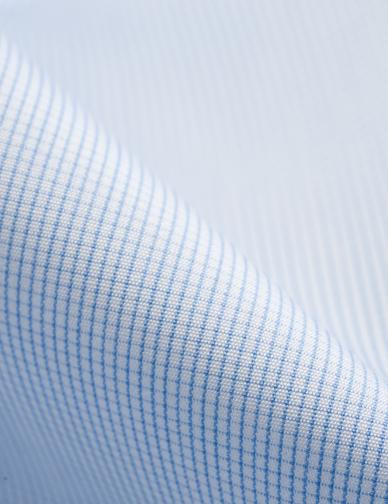
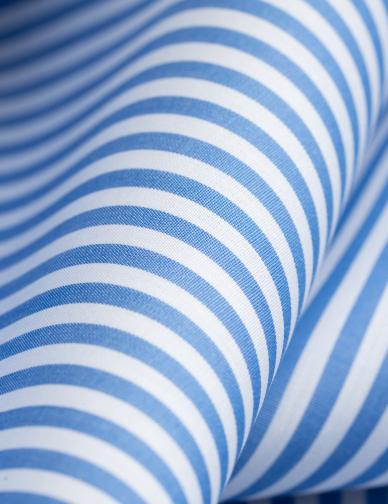
Alumo produce across the full vocabulary of fine shirting construction. Their poplin is the benchmark: a plain-weave fine cotton in the construction that is the standard for formal shirting worldwide. The Alumo poplin has a smoothness and a press quality that sets it apart from lesser alternatives in the same construction, covering the full range of formal shirting colours — white, pale blue, fine stripes — with the precision that formal shirt-making requires.
Their fine twill constructions offer a slight variation in visual interest while maintaining the formality of poplin. The Alumo twill in fine white or pale blue is appropriate for professional contexts where a slight surface character adds distinction.
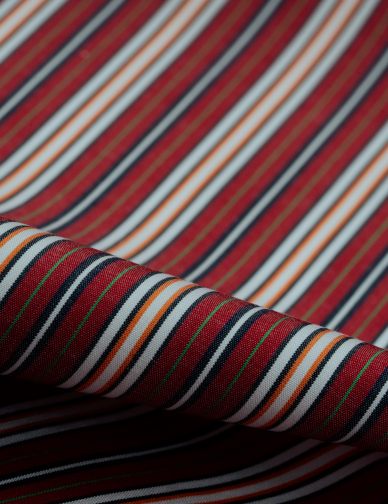
Beyond the formal foundations, Alumo also produce in end-on-end (a fine two-colour weave that reads as a subtle mélange from a distance), Oxford cloth for a more casual application, and a range of fine stripe and check constructions. The breadth of the collection means that clients who want Alumo quality across a full wardrobe of shirts can build that wardrobe from a single cloth house.
Alumo versus Thomas Mason — choosing between the two
The question clients most often ask when comparing Alumo and Thomas Mason is which is better. The honest answer is that they are different rather than ranked. Thomas Mason has the English shirting tradition — a slightly heavier hand, a crisper press quality, a cloth that is confident in its Britishness. Alumo has the Swiss precision standard — a softer hand, a finer surface, a cloth that is almost eerily smooth against the skin.
For formal professional shirting — white shirts for important meetings, formal shirts for occasions — Thomas Mason's Gold or Luxury poplin is our usual recommendation. The crispness and weight feel correct for formal contexts. For shirts that will be worn against the skin in warm conditions, where the comfort of the cloth is as important as its appearance, the Alumo smoothness is the choice.
Many clients who commission multiple shirts end up with both: Thomas Mason for their formal whites and pale blues, Alumo for the shirts they want to wear comfortably in Chennai's conditions. We will discuss this at the shirt consultation and show you samples from both houses so the distinction is apparent from the hand rather than the description.