The cutter — where the garment begins
The most important person in the creation of a bespoke garment is the cutter. The cutter is responsible for reading the client's body — not just measuring it, but understanding its particular proportions, how it holds weight, how it stands, what compensations need to be built into the pattern to account for asymmetries that every human body has. From this reading, the cutter drafts the pattern.
Pattern drafting is a technical skill developed over years of practice. A cutter who has been making jackets for twenty years has an accumulated library of solutions to fit problems — the high left shoulder, the sway back, the dropped seat, the forward-pitching sleeve — that a cutter with two years of experience simply does not have. Our head cutter has spent decades in this workshop, developing that library through every commission that has left this atelier.
The cutter also cuts the cloth — marking the pattern on the fabric and cutting it by hand with shears, not with a mechanical cutter and a stack of identical lengths. Each layer of cloth is cut individually and checked. This is slower than industrial cutting. It is also the only way to respect the directionality of a weave, the pattern repeat of a stripe or check, and the nap of a pile fabric like velvet.
The tailors — the hands that make the garment
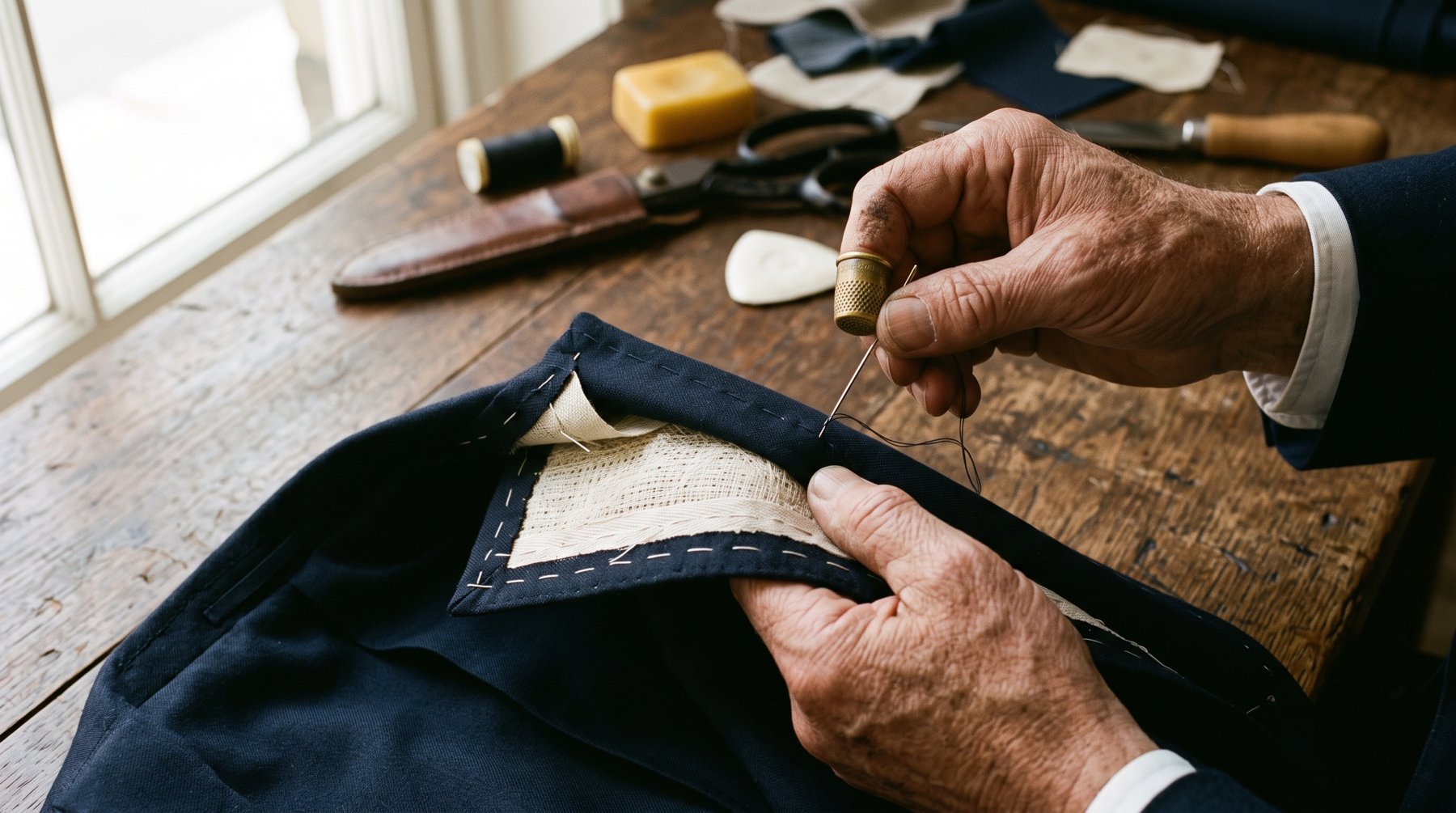
After cutting, the cloth passes to the tailoring team. In bespoke construction, the work is divided between machine sewing — for seams that need strength and precision — and hand sewing, for the parts of the garment where hand work produces a better result. The chest canvas, the lapels, the collar, the buttonholes, the final pressing — these are done by hand in a correctly made bespoke jacket.
Hand-padded lapels are one of the most specific skills in bespoke tailoring. The lapel in a well-made jacket rolls rather than lies flat — it has a soft, three-dimensional quality that changes slightly each time the wearer moves. This roll is created by padding the lapel canvas with hundreds of small stitches that compress the canvas slightly at the roll line. A machine cannot replicate this. A tailor with the right training and enough years of practice can produce a lapel that holds its roll for the life of the jacket.
Our tailors have been with the house for years, in most cases decades. This continuity matters: the house style — the specific character of how a shoulder is set, how a chest is cut, how a waist is suppressed — is transmitted not through a manual but through practice and proximity. A tailor who has spent years in this workshop makes garments that look like they come from this workshop.
The fitters — the intermediaries between the pattern and the body
At the basted shell fitting, the fitter reads the garment on the client's body and marks corrections. This requires the ability to see, simultaneously, the fit issues that are visible in the garment as it hangs and the adjustments to the pattern that will produce the right result when the garment is constructed. It is a diagnostic skill, not a mechanical one — the fitter is interpreting what the body and the garment are telling each other.
A good fitter can distinguish between a fit issue caused by a pattern error, a cutting error, or a cloth behaviour issue — and knows the appropriate correction for each. They can also distinguish between what the garment needs and what the client thinks the garment needs, which are not always the same thing. The fitter's job includes managing this conversation: listening to the client's concerns, explaining what they are seeing, and recommending the adjustment that will actually produce the right result.
The transmission of craft — how skill passes between generations
Tailoring skill is not taught from textbooks. It is acquired through apprenticeship — working alongside skilled practitioners, observing how they work, attempting the same tasks, being corrected, improving, and eventually reaching a level of competence that allows independent judgment. This transmission requires time: a tailor in training works under senior guidance for years before they are trusted to work independently on important commissions.
At The Black Lapel, the senior craftsmen have trained the junior ones. This is how it has always worked in tailoring — knowledge transferred person to person, adjusted and refined by each generation that holds it. The specific way we cut a lapel, the specific way we set a sleeve, the specific way we handle a difficult fit — these are inherited from the craftsmen who built this workshop and passed down to the people working here today.
This is what "since 1963" actually means when a tailor says it. Not just that the business has been in operation for over sixty years, but that the craft accumulated in those sixty years is present in the atelier today — in the senior hands that learned it early and have practiced it without interruption since.