After each wear — the thirty-second routine
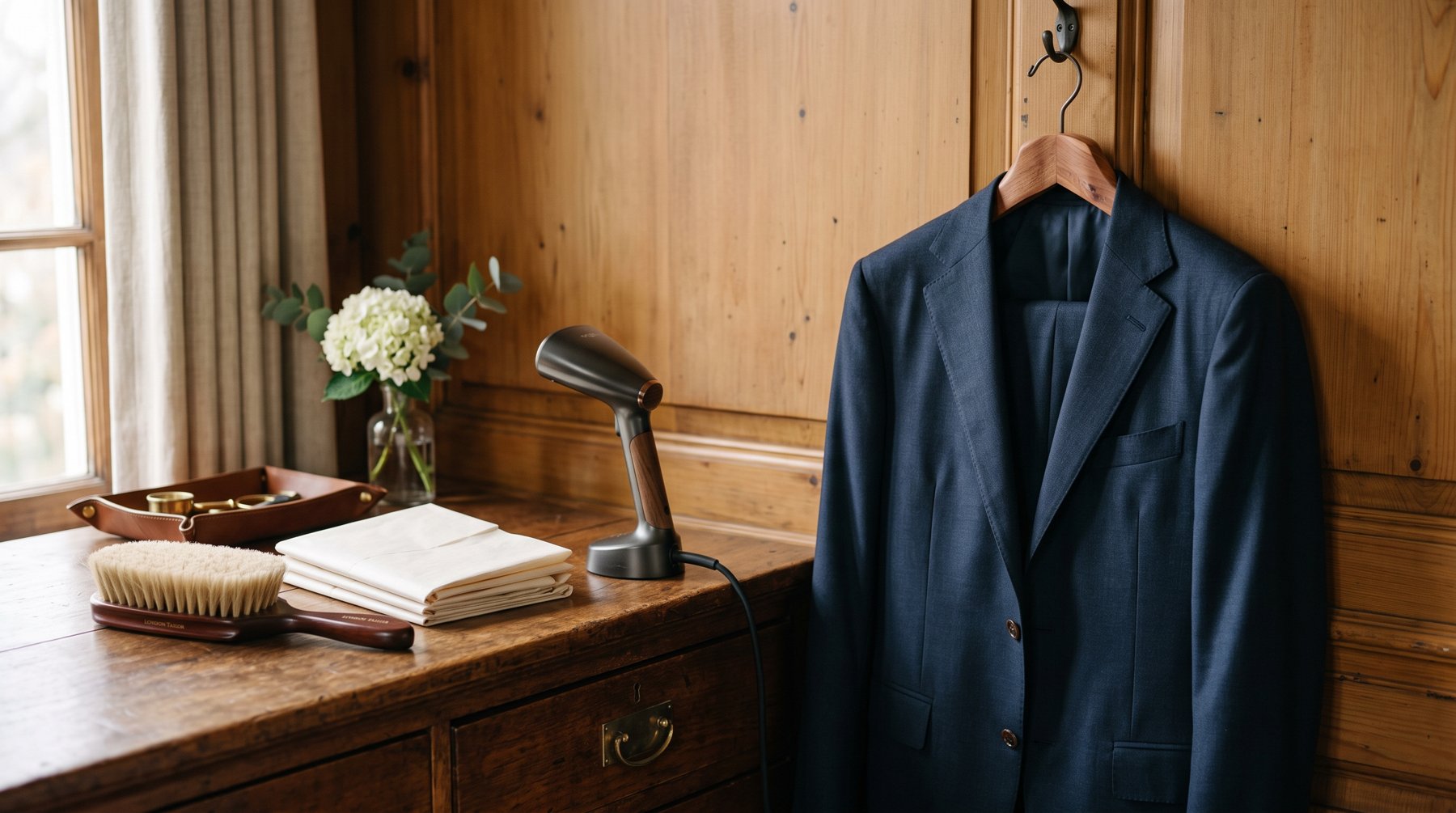
After every wear, do three things: hang the suit on a shaped shoulder (not a wire hanger, which deforms the shoulder), brush the cloth with a soft clothes brush (this removes dust and surface debris before it works into the weave), and allow the garment to rest for at least one day before wearing again.
The rest period is not optional if you want the garment to last. Wool is elastic, and the compression of a day's wear takes time to recover from. A suit worn daily without rest ages in months what a suit worn two or three times per week ages in years. If you wear suits daily, have at least two in rotation.
The clothes brush is the most underused garment care tool. Used regularly, it significantly extends the time between dry cleans — which is important because dry cleaning is one of the most damaging things you can do to a wool garment, done too often.
Dry cleaning — as rarely as possible
Dry cleaning is a solvent process that strips the natural oils from wool fibres over time. Repeated too often, it breaks down the fibre structure and shortens the cloth's life. The rule of thumb for a suit worn regularly: dry clean no more than once or twice per season.
Between cleans, use the brush and the hanging rest to maintain freshness. If the suit needs to be freshened between cleans, hang it in a well-ventilated space overnight, or in a bathroom while you run a hot shower — the humidity relaxes the fibres and removes surface odour without the chemical intervention of dry cleaning.
For spot treatment of specific marks, act quickly and use a clean white cloth dampened with cold water. Work from the outside of the mark inward to avoid spreading it. Do not rub vigorously; press and blot. If the mark does not respond, bring the garment to us — we can advise on the appropriate treatment for the specific cloth and mark. Attempting aggressive home cleaning on a fine worsted can cause damage that is difficult to reverse.
When you do dry clean, use a good dry cleaner who understands tailored garments — not a volume dry cleaner who presses suits on an automated form. The pressing after dry cleaning is important; an automated press does not respect the bespoke construction, particularly the roll of a hand-padded lapel.
Storage — how to keep the garment between wears
Hangers. Shaped wooden shoulder-width hangers, always. A cedar hanger is ideal — cedar has mild moth-repellent properties and absorbs moisture. Wire hangers distort the shoulder over time and should not be used for any garment you care about.
Bags. For garments in regular rotation, a hanging cloth garment bag (not plastic) in the wardrobe is appropriate. Cloth allows the garment to breathe; plastic traps moisture, which leads to mildew in Chennai's humidity. For garments in long-term storage — sherwanis, suits for specific occasions — a sealed garment bag with a cedar block or neem ball inside provides protection against insects.
Folding vs hanging. Suits and jackets should always be hung, not folded. The jacket is constructed in three dimensions and folding it collapses those dimensions in ways that create permanent creases. Trousers can be hung by the crease (on a trouser bar) or folded lengthwise and hung over a hanger bar — the crease should align with the trouser's own crease, not across it.
Moths. In Chennai, moths are a lesser problem than in cooler climates, but not absent. Cedar, neem, and lavender are natural deterrents; mothballs (naphthalene) work but leave a smell that is difficult to remove from fine cloth. Regular brushing and airing also disrupts moth activity. If you notice moth damage, bring the garment to us immediately — early damage can be repaired; extensive damage cannot.
Pressing at home — what to do and what to avoid
Pressing a bespoke garment at home is possible and, for minor travel creases, usually sufficient. The essential rule: never press without a pressing cloth between the iron and the garment. A dry iron directly on fine worsted will leave a permanent shine (the fibres are flattened rather than revived). A damp pressing cloth between iron and cloth allows steam to do the work.
Better than a direct iron is a steam iron used at a distance of two to three centimetres from the cloth, allowing the steam to relax the fibres without direct contact. This approach is particularly good for the jacket front and lapels, where direct pressing risks flattening the roll of the lapel or the slight convexity of the chest.
Never press the jacket lapels flat — a bespoke lapel has a hand-padded roll that should remain soft and curved. Press around the lapels, not over them. If the roll has been compressed in storage or transport, hang the jacket in a steamy bathroom for twenty minutes; the roll will recover without pressing.
Professional pressing — by someone who understands tailored garments — is always preferable to home pressing for important occasions. We press garments at the workshop when clients bring them in for fittings or adjustments; if you need a garment pressed before a specific occasion, we can typically accommodate a same-day press with advance notice.
Caring for bespoke shirts
Bespoke shirts in fine cotton, Egyptian or sea-island cloth benefit from careful washing and pressing. Machine washing on a gentle cool cycle (30°C) is appropriate for most fine cottons; hand washing is better for the finest cloths and for shirts with embellishment or French cuffs. Tumble drying is hard on fine cotton; air drying or drying flat is preferred.
Pressing a bespoke shirt should be done while it is still slightly damp, which makes the cotton easier to smooth. Press in order: collar first (spread the collar flat and press the points outward from the centre), then cuffs, then sleeves, then the body panels. The collar should be pressed with a firm, decisive stroke; a soft or half-pressed collar undermines the entire shirt.
Bespoke shirts typically have mother-of-pearl or high-quality resin buttons. These are more delicate than cheap plastic buttons. Remove the shirt from the washing machine before the spin cycle if the machine cannot control spin intensity, as high-speed spin can chip or crack quality buttons.
Caring for Indian ethnic wear
Silk sherwanis, bandhgalas and kurtas in fine cloth need specific care. Dry cleaning is generally the correct approach for embellished or embroidered pieces where home washing risks damaging the embroidery or distorting the structure. For plain silk kurtas, gentle hand washing in cold water with a mild detergent is possible; do not wring, but press gently in a towel and air dry.
Velvet ethnic wear — increasingly popular for winter weddings — should be dry cleaned exclusively. Velvet pile is directional; incorrect pressing flattens the pile permanently. Store velvet garments in a cloth bag, hanging, with nothing pressed against the velvet surface. Never iron velvet directly; if steaming is required, use a steaming rack that allows the pile to hang free.
For heavily embroidered sherwanis or bandhgalas, turn the garment inside out for storage to protect the embroidery from contact damage, and fold any embroidery-heavy panels with tissue paper between them. Zardozi embroidery, in particular, can snag if stored in contact with other garments.
Repairs — bring it back to us
For garments made at The Black Lapel, repairs are part of the ongoing relationship. A lining that has separated, a button that has fallen, a seam that has opened, a moth hole that needs reweaving — bring the garment to us. Most small repairs are done at no charge or at a minimal cost, and we know how to work with the specific cloths and construction methods we used in the original garment.
Do not attempt to repair a bespoke garment yourself using iron-on patches or craft glue. These solutions are visible and, in some cases, make the damage worse by bonding with the cloth in ways that are difficult to reverse. A professional repair by the original maker is always the right approach.